

BALI, KILASSULAWESI– Indonesia, supported by the United Nations Development Programme (UNDP) through the Climate Promise Project, has developed a roadmap for the tourism sector to reduce carbon emissions (decarbonization). This effort is a manifestation of Indonesia’s commitment to invite the world to collectively address and manage the impacts of climate change.
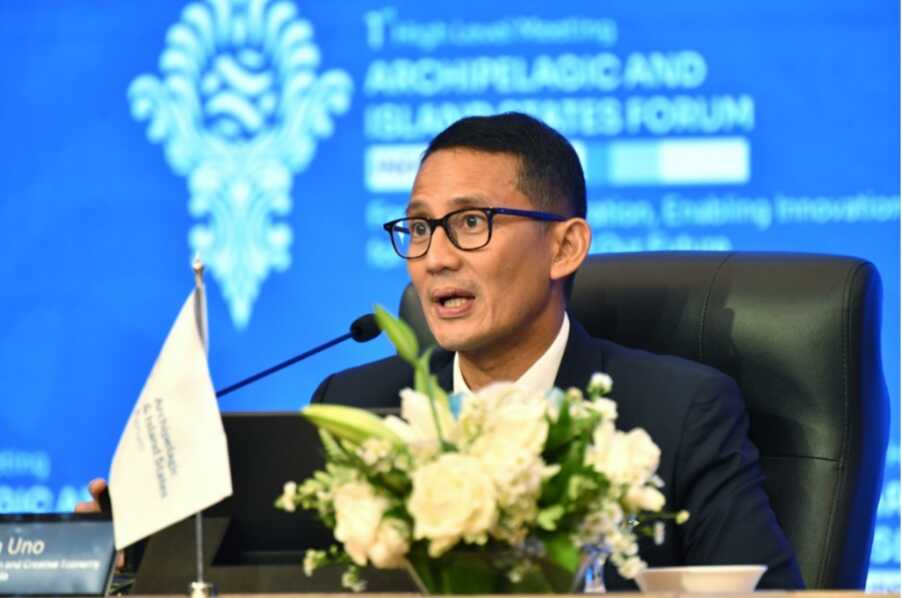
This document was launched at the side events of the 1st HLM of AIS Forum, the Blue Economy High-Level Dialogue, Monday, 9 October 2023. The document was handed over to the Ministerial Meeting (MM) of the 2023 Archipelagic and Island States (AIS) Forum at Bali Nusa Dua Conference Center (BNDCC) 1, Bali, Tuesday, 10 October 2023.
The Minister of Tourism and Creative Economy/Head of the Tourism and Creative Economy Agency Sandiaga Salahuddin Uno stated that the roadmap is a fulfillment of Indonesia’s responsibility towards climate sustainability and resilience.
“The Ministry of Tourism and Creative Economy would like to convey the tourism sector’s commitment to exploring best practices related to decarbonization and climate action in the tourism sector,” he said after the signing ceremony.
In general, decarbonization programs aim to reduce energy consumption while improving efficiency. This program comprehensively addresses various issues, disseminates actions, and tackles challenges in the tourism industry.
Based on the roadmap, the immediate agenda is to measure and calculate the lower emission limit and the target for reducing carbon emissions in the tourism sector.
“At the same time, we will prepare a reporting system to accompany the journey of tourism towards zero emissions,” Sandiaga added.
As a follow-up action, the Ministry of Tourism and Creative Economy is collaborating with the Coordinating Ministry for Maritime Affairs and Investment and the Ministry of Energy and Mineral Resources under the ‘Climate Promise Project’ to conduct an energy and waste management survey for 20 hotels in the Indonesia Tourism Development Corporation (ITDC) area in Nusa Dua, Bali. The development of mitigation action plans will also follow the survey.
“Similar actions will be extended to five other Super Priority Tourism Destinations (DPSP) in Indonesia and are expected to be replicated in other regions, combining domestic mitigation actions with the sector’s contribution to Indonesia’s Nationally Determined Contribution (NDC) document (a document containing a country’s climate commitments and actions communicated to the world),” Sandiaga explained.
“The ‘Tourism Sector Decarbonization Roadmap’ is the first step and will be continuously updated in the future to align with developments in the energy sector, waste management, and overall developments in the tourism industry.
The ministry is committed to collaborating with the Ministry of Environment and Forestry, relevant government agencies, and other stakeholders to refine the roadmap’s scope.
“The roadmap’s coverage will also be expanded. The program will be periodically updated, and the objectives may be altered to achieve zero emissions faster. This significant undertaking begins today to create business and job opportunities that we refer to as green tourism jobs,” Sandiaga concluded.(*)